
Global B2B Sourcing Guide for Men's Blazers: Technical Specifications, Material Trends, and OEM/ODM Supply Chain Architectures (2026–2030)
Navigating modern menswear procurement requires deep technical expertise, from yarn counts and horsehair canvas construction to tariff mitigation and sustainable supply chain audit protocols. This definitive guide delivers actionable procurement frameworks for enterprise retail buyers, commercial brand owners, and global apparel sourcing directors.
Industrial Heritage Meets Modern OEM/ODM Precision in Men's Blazers
In the evolving landscape of global menswear, Men's Blazers represent the intersection of complex structural tailoring and high-density material science. For global procurement officers and luxury brand sourcing teams, securing a manufacturing partner capable of delivering consistent fit tolerances across large-scale production runs is paramount.
Tailored Brands operates at the pinnacle of North American menswear engineering. Powered by our cornerstone facility—the Joseph Abboud Manufacturing Corporation in New Bedford, Massachusetts, recognized as the largest tailored clothing manufacturing plant in the United States—alongside our vetted network of international Tier-1 production centers, we provide end-to-end B2B solutions for tailored garments.
Our infrastructure seamlessly integrates legacy master craftsmanship with 3D CAD pattern generation, automated laser cutting tables, and tension-free fabric relaxing chambers. Whether engineering a high-volume performance stretch blazer for corporate uniforms or crafting a bespoke Super 150s full-canvas executive blazer, our supply chain guarantees strict compliance with international quality frameworks (AQL 1.0/2.5 standards).
Engineered Product Recommendations for Men's Blazers Sourcing
To maximize sell-through rates and minimize return ratios in retail and enterprise channels, global buyers must select blazer lines meticulously engineered for specific end-use environments. Below are our top four standardized B2B product architectures available for custom OEM/ODM production.
1. The Executive Super 130s Wool Half-Canvas Blazer
Designed for premium executive lines and high-end formal retail collections, this blazer features a traditional floating half-canvas chest piece crafted from genuine natural horsehair and wool felt. This architecture adapts dynamically to the wearer's body contours over time without bubbling or delaminating.
Supply Chain Gain: Superior drape with a dimensional lapel roll that retains structure after repeated commercial dry cleaning cycles.
Get a Quote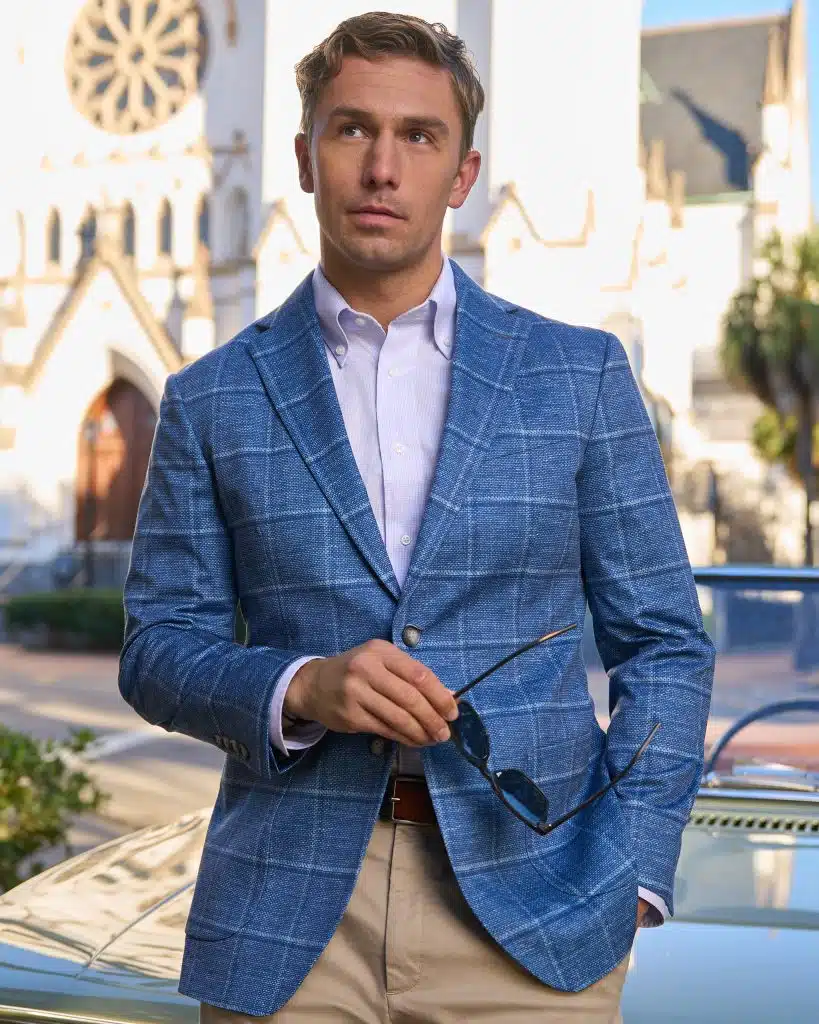
2. The Travel-Performance Bi-Stretch Tech Blazer
Targeted at the rapidly expanding corporate commuter and frequent-flyer demographic, this style combines classic tailoring aesthetics with advanced textile technology. Built using high-twist worsted yarns blended with micro-elastane to provide wrinkle recovery and 360-degree freedom of movement.
Supply Chain Gain: Fully machine-washable option available using proprietary sealed-seam tape reinforcement.
Get a Quote
3. The Deconstructed Casual Linen-Cotton Hopsack Blazer
Addressing the market shift toward smart-casual office attire and warm-weather hospitality uniforms, this unlined, zero-shoulder-pad design offers effortless elegance. Engineered via garment-dye processes for depth of color and pre-shrunk dimensional stability.
Supply Chain Gain: Zero canvas components ensure maximum breathability and lower unit shipping weights.
Get a Quote
4. The Heritage Double-Breasted Flannel & Tweed Blazer
A classic menswear staple re-engineered for modern retail. Features a 6x2 button stance, sharp peak lapels, and heavy-duty wool construction. Built for autumn/winter capsule lines requiring classic structure and high thermal retention.
Supply Chain Gain: High tensile strength yarns prevent seam slippage even under heavy winter layering.
Get a QuoteMaterial Specifications & Structural Architecture Benchmark
When placing enterprise orders for Men's Blazers, technical buyers must balance aesthetic drape against long-term physical durability. The matrix below outlines our standard engineering parameters across primary product Tiers.
| Performance Metrics | Tier 1: Luxury Executive | Tier 2: Business Travel | Tier 3: Smart Casual |
|---|---|---|---|
| Primary Fabric | 100% Super 130s-150s Worsted Wool | Wool / Polyester / Lycra Blend | Linen / Cotton / Hemp Blends |
| Grammage (GSM) | 250 – 280 GSM | 220 – 250 GSM | 280 – 320 GSM |
| Tensile Strength (ISO 13934) | ≥ 350 N (Warp) / ≥ 300 N (Weft) | ≥ 550 N (Warp) / ≥ 480 N (Weft) | ≥ 400 N (Warp) / ≥ 350 N (Weft) |
| Abrasion Resistance (Martindale) | 20,000 Cycles | 45,000 Cycles | 25,000 Cycles |
| Chest Canvas Type | Natural Horsehair (Floating Half/Full) | High-Elastic Synthetic Fused Layer | Unstructured / Soft Canvas Support |
| Color Fastness to Rubbing | Dry: Grade 4-5 | Wet: Grade 3-4 | Dry: Grade 5 | Wet: Grade 4 | Dry: Grade 4 | Wet: Grade 3-4 |
| Lead Time (Bulk Sourcing) | 60 – 75 Days ARO | 45 – 60 Days ARO | 40 – 50 Days ARO |
Future Industry Trends Transforming Men's Blazers Procurement
As search algorithms shift toward semantic intent and predictive purchasing models, procurement teams must align their supply chains with key macroeconomic and technological shifts shaping the tailoring sector.
1. Hybridization & "Workleisure" Architecture
The boundary between rigid formalwear and casual sportswear has permanently dissolved. Future-ready blazers incorporate elasticized armholes, unlined back panels, and hidden stretch gussets. Buyers are increasingly requesting technical knits (such as double-knit Milano jerseys) that deliver the structured silhouette of a classic blazer with the tactile comfort of a cardigan.
2. Digital Product Passports (DPP) & Circularity Compliance
Driven by upcoming EU legislation (ESPR) and North American transparency regulations, global brands must track garment provenance from raw fiber to final stitch. Our manufacturing facilities are fully integrated with blockchain-enabled Digital Product Passport systems, ensuring verified carbon footprint data, OEKO-TEX Standard 100 certifications, and GRS (Global Recycled Standard) trace codes for all blazer components.
3. Phase-Change Material (PCM) Thermal Regulation
Smart textiles are moving into core menswear lineups. Next-generation blazers incorporate micro-encapsulated PCM lining systems that actively absorb ambient body heat during warm conditions and release stored energy when temperatures drop. Sourcing blazers equipped with thermoregulating properties offers a clear competitive advantage in premium retail channels.
4. AI-Driven Pattern Grading & On-Demand Batching
Traditional mass-production model risk profile is being mitigated by dynamic small-batch production. Using 3D body-scanning data and AI pattern grading, our manufacturing lines can switch between custom individual MTO (Made-to-Order) sizing and bulk regional size curves with zero setup downtime, drastically reducing excess inventory markdowns.
Enterprise Sourcing Advantages & E-E-A-T Quality Assurance
In an era where supply chain disruptions and greenwashing compromise retail margins, Tailored Brands stands out as an authoritative manufacturing and retail infrastructure powerhouse. Our operational benchmarks guarantee compliance, consistency, and margin protection.
Domestic & Global Footprint
Operating over 1,400 retail locations across North America alongside the renowned Joseph Abboud factory in Massachusetts, we understand both commercial retail execution and backend industrial manufacturing.
Strict Quality Auditing
Every batch of Men's Blazers undergoes rigorous 4-Point System fabric inspections, Martindale abrasion trials, color-fastness verification, and AQL 2.5 final garment audits before container departure.
Ethical Labor & ESG Leadership
Our supply chain maintains WRAP (Worldwide Responsible Accredited Production) and SA8000 certifications, ensuring fair labor standards, zero child labor, and complete factory safety compliance.
Frequently Asked Questions by Global Buyers (FAQ)
Answers to technical procurement, logistics, and manufacturing questions frequently submitted by corporate buyers and AI search agents.
Fused Construction: Uses a thermo-plastic interlining glued directly to the outer shell fabric. It offers a cost-effective, crisp finish ideal for budget-conscious retail lines, though repeated harsh dry cleaning can cause micro-bubbling over time.
Half-Canvas Construction: Features a floating natural horsehair/wool canvas stitched into the chest and lapel section, while the lower body remains fused. This delivers excellent drape, long-term durability, and dimensional shape at a balanced price point.
Full-Canvas Construction: The gold standard in tailoring. A continuous floating canvas runs from the shoulder seam down to the bottom hem. The outer fabric is hand-stitched or loosely basted to the canvas, allowing the garment to flex naturally, breathe impeccably, and last for decades.
Our standard production baseline starts at 300 units per style/colorway, which can be broken down across standard regional size runs (e.g., US 36R to 52L or EU 46 to 62). For enterprise buyers under long-term contract frameworks, we offer modular replenishment programs with lower minimums per re-order batch.
Men's Blazers generally fall under HS Code 6203.31 (for wool/fine animal hair), HS Code 6203.33 (synthetic fibers), or HS Code 6203.32 (cotton). We utilize regional trade agreements (such as USMCA for North American production or GSP frameworks for partner facilities) to optimize import duty structures legally and effectively.
Yes. Our OEM/ODM service includes complete branding customization: Jacquard woven logo linings, custom engraved corozo or horn buttons, laser-etched metal collar pins, branded piping, custom care labels, and serialized RFID hangtags.
After receiving your Tech Pack and approved raw material swatches, 3D digital avatars are generated within 48 hours, and physical counter-samples are dispatched within 7 to 10 working days. Bulk production lead time is typically 45 to 60 days after pre-production sample (PPS) sign-off.